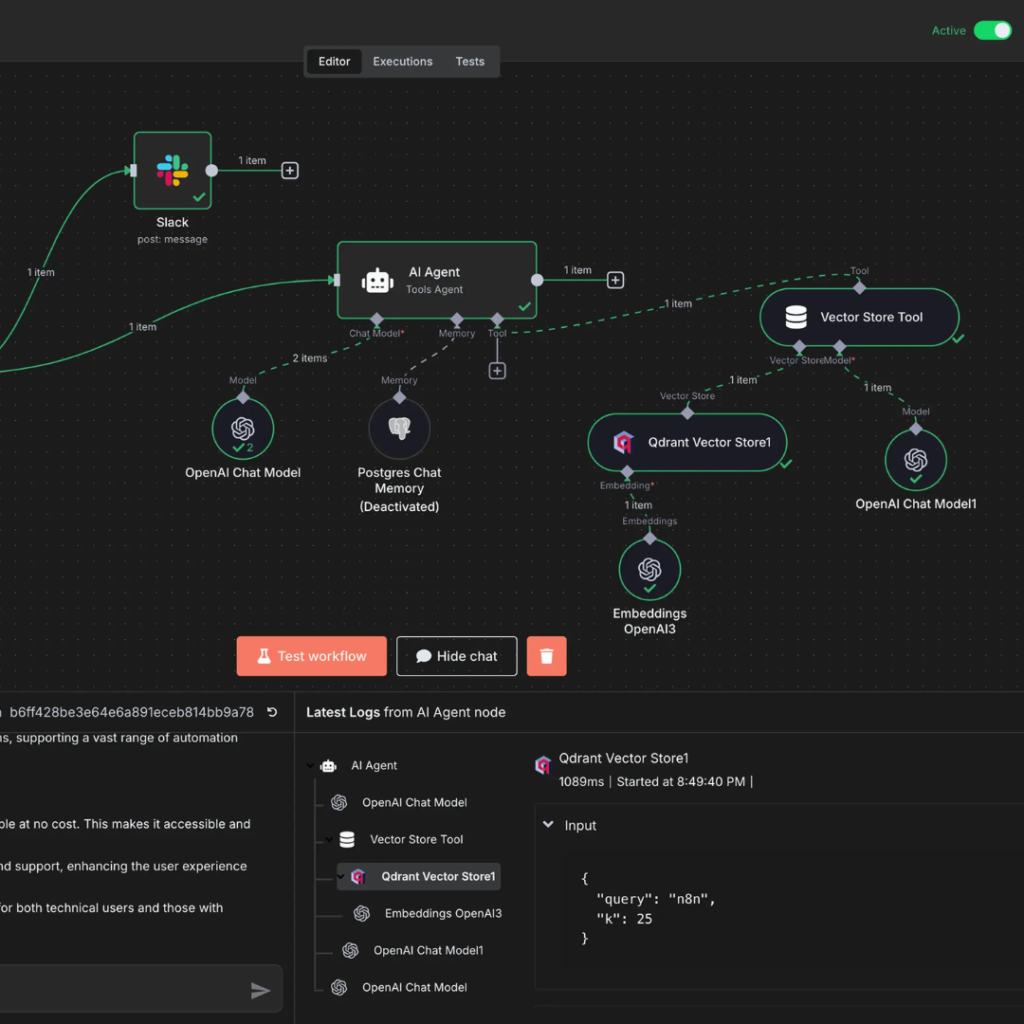
Traditional workflows follow fixed steps: if this, then that. AI agents are different — they reason. In n8n, an AI agent is a workflow that uses a language model to decide what to do next, which tools to call, and in what order. You describe the goal; the agent figures out the path.
THE BUILDING BLOCKS
Every n8n AI agent has four parts. The model — the language model doing the thinking, like OpenAI or another provider you connect. Tools — the actions the agent can take: searching the web, querying a database, calling your APIs, sending messages. Memory — so the agent remembers the conversation across steps. And the prompt — your instructions defining the agent’s role and rules.
A SIMPLE EXAMPLE
Imagine a customer-support agent. A customer asks ‘where is my order?’ on chat. The agent receives the message, decides it needs order data, calls your store’s API tool with the order number, reads the result, and replies in natural language. No rigid decision tree — if the customer then asks about returns, the agent adapts and uses the returns tool instead.
WHAT YOU NEED TO KNOW
AI agents cost money per run because every decision calls the language model — keep prompts tight and limit tool loops. Always test with real, messy inputs before going live. And give the agent clear guardrails in its prompt: what it’s allowed to do, and what it must never do.
Start simple: build an agent that answers questions from your own FAQ document. It’s the fastest way to understand how models, tools and memory fit together — and it’s genuinely useful from day one.
KEEP LEARNING
Want to go deeper? These official n8n resources will help:
n8n Quick Start Tutorial: Build Your First AI Agent [2026] — includes downloadable workflow templates